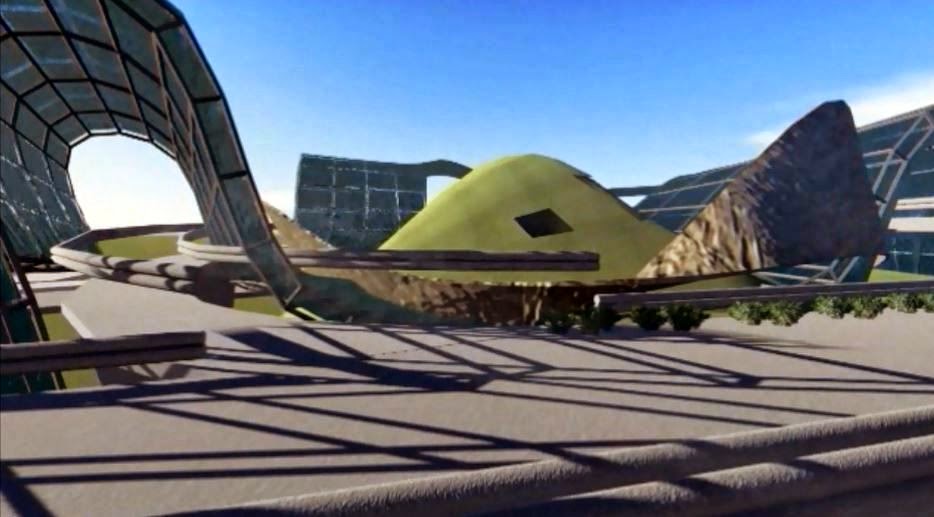
Aural Architecture : how is it a sustainable design ?: grey water from the neighborhood is pumped into the site and treated through landscape plants to get fresh water which is again given bac...
Showing posts with label rajnikanth. Show all posts
Showing posts with label rajnikanth. Show all posts
Sunday, 27 April 2014

how is it a sustainable design ?

Friday, 18 April 2014

Monday, 31 March 2014
How do we process Urban noise ? Secret revealed !!!
| Standing wave |

How do we process Urban Noise ?Secret revealed !!!
water flowing at a certain velocity from a specific height and even birds chirp has the same frequency as Urban noise in this case Car honking Aeroplane noise ,etc so when two sound of the same frequency are merged IN THE opposite direction STANDING WAVES ARE CREATED.
WHAT ARE STANDING WAVES ?A standing wave – also known as a stationary wave – is a wave that remains in a constant position.This phenomenon can occur because the medium is moving in the opposite direction to the wave, or it can arise in a stationary medium as a result of interference between two wa ves traveling in opposite directions.
Saturday, 22 March 2014
What is aural architecture ?
What is aural architecture ?
In our techno-visual culture, the ascendancy of vision as the primary means for sensing the physical
world has undermined the importance of hearing. Yet the aural experience of an environment is
critically important to the social and emotional well-being of the inhabitants.Listening has been proved as the highest order among all other senses .You know Why ?
We dont listen only through our ears ,we listen through our whole body _by the vibrations .So a user can perceive a space through listening .
An aural space is thus an area where inhabitants can hear sonic events, and this definition of space is often unrelated to the visual experience.
However, we tend to only
recognize the aural architecture of a space when its hostile and corrosive acoustics transform
background sounds into a deafening roar.
Aural architecture2 refers to the human experience of sound-in-space; the aural architecture of a space modifies the experience of sound sources as well as providing a means for experiencing passive objects and geometries directly.
Aural architecture contains at least five types of spatiality:
navigational,
social,
musical,
aesthetic,
and symbolic.
Friday, 21 March 2014
How to process Urban noise
How to process ?
Flow
of Water and birds chirp has the capacity to curb Urban noise around us
in the metropolitan cities . Flow of water and noise has the same frequency so
when overlapped it has the power to
nullify the effect through the concept of Standing wave .As architects we do
not consider the Aural experience of a space ,by increasing the greenery and
flow of water as urban elements ,the experience is enhanced.

Tuesday, 18 March 2014

Monday, 17 March 2014
Technique behind epidaurus
Acoustic traps
The corrugations on the surface of
the seats act as natural acoustic traps. Though this effect would seem to also
remove the low frequencies from the actors' voices, listeners actually fill in
the missing portion of the audio spectrum through a phenomenon known as virtual
pitch. The human brain reconstructs the missing frequencies, producing the
virtual pitch phenomenon, as in listening to someone speaking on a telephone
with no low end.
The findings are detailed in the
April issue of the Journal of the Acoustics Society of America.
Amazingly, the Greek builders of the
theater did not themselves understand the principles that led to the
exceptional audibility of sound from the stage.
Attempts to recreate the Epidaurus
design never quite matched the original. Later seating arrangements featured
other materials, such as wood for the benches, an approach which may have
ultimately derailed the design duplication effort.
Saturday, 15 March 2014

Wednesday, 5 March 2014
form from sound
Sound can create form
the way sound is articulated around us helps our aural sense to perceive it in such a way that it tends to visualize the pattern in which it moves

the way sound is articulated around us helps our aural sense to perceive it in such a way that it tends to visualize the pattern in which it moves
here we have tried to create a helical form through the buzzers arrrnged and programmed to be articulated inside a glass box .so when a user is made to listen ,he percieves the sphere around him not the cuboid .
Subscribe to:
Posts (Atom)