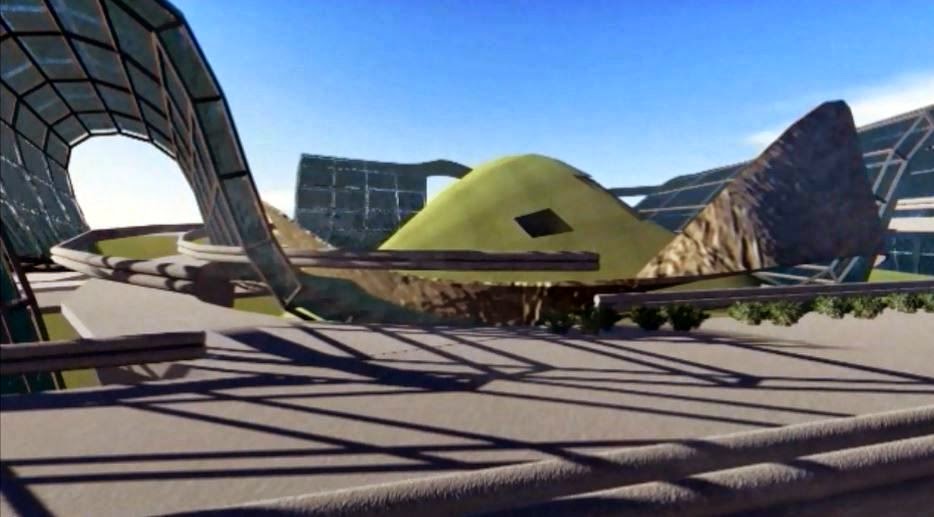
Aural Architecture : how is it a sustainable design ?: grey water from the neighborhood is pumped into the site and treated through landscape plants to get fresh water which is again given bac...
Showing posts with label sustainable. Show all posts
Showing posts with label sustainable. Show all posts
Sunday, 27 April 2014

how is it a sustainable design ?

Friday, 18 April 2014

Thursday, 17 April 2014

Saturday, 5 April 2014
Monday, 31 March 2014
How do we process Urban noise ? Secret revealed !!!
| Standing wave |

How do we process Urban Noise ?Secret revealed !!!
water flowing at a certain velocity from a specific height and even birds chirp has the same frequency as Urban noise in this case Car honking Aeroplane noise ,etc so when two sound of the same frequency are merged IN THE opposite direction STANDING WAVES ARE CREATED.
WHAT ARE STANDING WAVES ?A standing wave – also known as a stationary wave – is a wave that remains in a constant position.This phenomenon can occur because the medium is moving in the opposite direction to the wave, or it can arise in a stationary medium as a result of interference between two wa ves traveling in opposite directions.
Saturday, 29 March 2014

Wednesday, 26 March 2014
How sound defines space ?
how Aural architecture looks at sound
as design?
: how sound defines space, creates realms of privacy or society, and produces a sense of place.
: how sound defines space, creates realms of privacy or society, and produces a sense of place.
With
environmental sound, LOUDNESS and
the quality of REVERBERATION mainly
determine the kind of space that is perceived, enclosed or open, large or small
(see DIFFUSE
SOUND FIELD,FREE
FIELD).
The sense of speeding motion is usually perceived by the presence of a DOPPLER
EFFECT.
Buildings come to exist as sites of memory and imagination.
Any built space, whether constructed for habitation or utility, resonates with
the human activity that has occurred within it. Our experience of a space is
influenced by many things; by knowledge of the functions of the space, by
cultural associations, by memory and imagination. The way we experience a space
is determined largely by our aural perception of that space. One can be in a
room in complete darkness and yet still have a powerful sense of our own
physical presence within it, through the sound of footfall, of the voice and
even the sound of our our breath.
Monday, 24 March 2014
what is silence ?
The term 'silence' is not referring mere absence of sound,
but the spatial atmosphere related to our independent sensory and mental state,
which could be listened, observed, known and even touched.
Saturday, 22 March 2014
What is aural architecture ?
What is aural architecture ?
In our techno-visual culture, the ascendancy of vision as the primary means for sensing the physical
world has undermined the importance of hearing. Yet the aural experience of an environment is
critically important to the social and emotional well-being of the inhabitants.Listening has been proved as the highest order among all other senses .You know Why ?
We dont listen only through our ears ,we listen through our whole body _by the vibrations .So a user can perceive a space through listening .
An aural space is thus an area where inhabitants can hear sonic events, and this definition of space is often unrelated to the visual experience.
However, we tend to only
recognize the aural architecture of a space when its hostile and corrosive acoustics transform
background sounds into a deafening roar.
Aural architecture2 refers to the human experience of sound-in-space; the aural architecture of a space modifies the experience of sound sources as well as providing a means for experiencing passive objects and geometries directly.
Aural architecture contains at least five types of spatiality:
navigational,
social,
musical,
aesthetic,
and symbolic.
In our techno-visual culture, the ascendancy of vision as the primary means for sensing the physical
world has undermined the importance of hearing. Yet the aural experience of an environment is
critically important to the social and emotional well-being of the inhabitants.Listening has been proved as the highest order among all other senses .You know Why ?
We dont listen only through our ears ,we listen through our whole body _by the vibrations .So a user can perceive a space through listening .
An aural space is thus an area where inhabitants can hear sonic events, and this definition of space is often unrelated to the visual experience.
However, we tend to only
recognize the aural architecture of a space when its hostile and corrosive acoustics transform
background sounds into a deafening roar.
Aural architecture2 refers to the human experience of sound-in-space; the aural architecture of a space modifies the experience of sound sources as well as providing a means for experiencing passive objects and geometries directly.
Aural architecture contains at least five types of spatiality:
navigational,
social,
musical,
aesthetic,
and symbolic.

Friday, 21 March 2014
How to process Urban noise
How to process ?
Flow
of Water and birds chirp has the capacity to curb Urban noise around us
in the metropolitan cities . Flow of water and noise has the same frequency so
when overlapped it has the power to
nullify the effect through the concept of Standing wave .As architects we do
not consider the Aural experience of a space ,by increasing the greenery and
flow of water as urban elements ,the experience is enhanced.
Tuesday, 18 March 2014

Sound healing
"Sound is the medicine of the future." Edgar Cayce
Most ancient cultures used the seemingly magical power of sound to heal.
The Aboriginal people of Australia are the first known culture to heal with sound.
The Egyptian and Babylonian cultures used drums and rattles, two of the earliest known musical instruments. The low frequency sounds from drums and the ultra sound created by rattles are both now known to accelerate healing.
In the Greco-Roman period healing temples were used for "incubation", a process in which patients underwent "dream sleep", among other known modalities. It seems likely that music was used therapeutically during their stay and the reverberant spaces of the temples enhanced the efficiency of acoustic instruments, a function of the solid stonewalls of temples and sanatoria.
Resonance may be the most important principle of sound healing and has various definitions.
The resonance principle relates to the cellular absorption of the healing sounds and/or their harmonics.
Most ancient cultures used the seemingly magical power of sound to heal.
The Aboriginal people of Australia are the first known culture to heal with sound.
The Egyptian and Babylonian cultures used drums and rattles, two of the earliest known musical instruments. The low frequency sounds from drums and the ultra sound created by rattles are both now known to accelerate healing.
In the Greco-Roman period healing temples were used for "incubation", a process in which patients underwent "dream sleep", among other known modalities. It seems likely that music was used therapeutically during their stay and the reverberant spaces of the temples enhanced the efficiency of acoustic instruments, a function of the solid stonewalls of temples and sanatoria.
Resonance may be the most important principle of sound healing and has various definitions.
The resonance principle relates to the cellular absorption of the healing sounds and/or their harmonics.
Monday, 17 March 2014

Saturday, 15 March 2014
Subscribe to:
Posts (Atom)